Category Archives: computer

The Games: Summer Edition, a computer game for the Amiga by Epyx 1988

The Epyx Games – The Games: Summer Edition

We’re back to the Olympian playing field with the Amiga version of The Games: Summer Edition, distributed in 1988 by U.S. Gold and developed by Code Monkeys for Epyx. There were versions of the game made for the venerable C64 too, as well as arch Amiga rival the Atari ST, as well as for the Apple II and DOS.

Like the original Summer Games, this reboot was made to capitalize on an Olympic year. The very next summer games, in fact, taking place in Seoul, South Korea. As usual for this series, there was no Olympic branding to be found in Summer Edition, as the product wasn’t an official IOC license. Of course, we all knew what grand, international sporting event we were actually playing in.

There are eight Olympic-style events on display here: Cycling, Hurdles, Pole Vault, Hammer Throw, Uneven Parallel Bars, Archery, Rings and Diving. It’s also nice to see appropriately epic closing ceremonies make a return to the series. Since the game was made on the Amiga, the graphics are a pretty big notch above the previous iterations. The audio quality of the music is also a standout, although the compositions disappointingly generic for a Games title. Where are the groovy riffs? Gameplay is suspect as well. Most of the events devolve into the dreaded joystick waggling contest, and both of the gymnastic events, the rings and the parallel bars, take the gold in “I Have No Idea What I’m Doing”. Trying to play them, with all their complicated joystick movements and contextual timing, one can see why certain Olympic events were left out in the other games. With an Olympian amount of practice, I’m sure people could figure things out and put on a good athletic performance. As for me, I’ll just rest here under the bars and wait for the medics to carry me out.

Every game in the Epyx Games series will be featured in posts all during the Sochi 2014 Winter Olympics. Here are the links to the other articles:

The Epyx Games: Summer Games on the C64
The Epyx Games: Summer Games II on the C64
The Epyx Games: Winter Games on the C64
The Epyx Games: World Games on the C64
The Epyx Games: California Games on the C64
The Epyx Games: California Games II on PC (DOS)
The Epyx Games – The Games: Winter Edition on Amiga
The Epyx Games – The Fail Reel

For more information on Epyx and the Games series, consult your local Dot Eaters entry.

Image from California Games II, a computer game by Epyx 1990

The Epyx Games: California Games II on PC (DOS)

Welcome, moondoggies, to more sun-bleached sporting hijinks in California Games II, released by Epyx for the PC in 1990 as a sequel to their popular California Games. It was programmed by Gil Colgate, Kevin Furry, Darrell Fetzer and Jesse Taylor. Art was handled by Arthur Koch, Matthew Crysdale, Paul Vernon, Collette Michaud and Joel Mariano. Chris Ebert, Bob Aron and Chris Grigg did sound design. The game was produced by Matt Householder, and additional design was done by Tom Schumacher. You can really see the personnel rosters climb as the games advance, can’t you? Initially released for DOS, California Games II also saw light on the two big 16-bit computers of the era, the Amiga and Atari ST, along with later console versions for SNES and the SEGA Master System.

This post covers the DOS version, which is a great entry in the Epyx Games series. The available events here are Hang Gliding, Snowboarding, Jet Surfing (Jet Ski), Bodyboarding, and Skateboarding. I’d have to say that personally, I enjoy snowboarding and skateboarding the most out of this title. Although what to do with the helicopter in snowboarding is initially inscrutable (protip: don’t land on the platform, hover over the snowy slope next to it and hit the fire button to jump out), the multi-stage gameplay is a blast and mighty harrowing as you careen down the mountain. The jetskiing event is by far the worst, with little to do but try and keep between the buoys with a stiffly-handling watercraft. There is also no sound effects in this event, except for the music that constantly plays. Considering that the player is prompted before the race to “rev up your engines”, it’s funny that there’s no actual engine sounds! Bodyboarding is merely blah, although the graphics in this one really give me the idea that I’m actually playing a classic graphic adventure by Sierra Online.  Maybe a sequel to Codename Iceman or something. Matching the Sierra Online adventure game ethos are some of the dire ends you can come to. Things are not as laid-back in California as they seem.

The music is a bit better here than in the previous California Games, and player control seems responsive and tight. In all, a lot of fun to play. It’s totally tubular..although take it easy approaching the tunnels in while on your skateboard, or you might leave a permanent mark. Now THAT’S bogus, dude.

Every game in the Epyx Games series will be featured in posts all during the Sochi 2014 Winter Olympics. Here are the links to the other articles:

The Epyx Games: Summer Games on the C64
The Epyx Games: Summer Games II on the C64
The Epyx Games: Winter Games on the C64
The Epyx Games: World Games on the C64
The Epyx Games: California Games on the C64
The Epyx Games – The Games: Summer Edition on Amiga
The Epyx Games – The Games: Winter Edition on Amiga
The Epyx Games – The Fail Reel

For more bitchin’ info on the history of Epyx, glide over to your local Dot Eaters entry, man!

Excerpt from California Games, a computer game by Epyx 1987

The Epyx Games: California Games on the C64

Time for some totally awesome and knarly sports, dudes!

California Games was released for the Commodore 64 by Epyx in 1987, featuring six rad events straight outta the Golden State. It was designed by Chuck Sommerville and Jon Leupp, along with Ken Nicholson and Kevin Norman. Lending their graphical talents were Jenny Martin, Suzie Greene, Sheryl Knowles and Paul Vernon.  Taking sound duties was Chris Grigg. The sun-soaked sports featured in the game are Half Pipe, Foot Bag, Surfing, Skating, BMX, and Flying Disc.

This game might have been the most financially successful of the Epyx Games series, but I don’t know… it doesn’t quite gel for me like the previous titles. Some of the events are fun; trying to catch the break in Surfing is entertaining, along with some neat animations if you wipe out. Half Pipe is hella complicated when you first start, although after a tonne of practice you can get into a rhythm with the various skateboard moves that feels great.  The only other sport in the package that I enjoy is Flying Disc, aka Frisbee. The other events are very picky about timing, and the sidelong view in Skating and BMX makes it hard to judge exactly where your character is in relation to the sidewalk/track.

It is also disappointing that you don’t get something similar to the national anthems from the previous games.  Here you just choose from among a few different sponsors, with no musical theme attached to them.  Speaking of music, the overall score isn’t the best of the series by any means. Players are also left missing the opening and closing ceremonies…. after a static render of your trophy you’re just dumped unceremoniously back to the main menu when completing a full circuit of games. So California Games is a bit bogus, but still better than getting gagged with a spoon.

Every game in the Epyx Games series will be featured in posts all during the Sochi 2014 Winter Olympics. Here are the links to the other articles:

The Epyx Games: Summer Games on the C64
The Epyx Games: Summer Games II on the C64
The Epyx Games: Winter Games on the C64
The Epyx Games: World Games on the C64
The Epyx Games: California Games II on PC (DOS)
The Epyx Games – The Games: Summer Edition on Amiga
The Epyx Games – The Games: Winter Edition on Amiga
The Epyx Games – The Fail Reel

For more information on Epyx, grok your local Dot Eaters article, dude!

The Epyx Games: Summer Games on the C64

There have been a lot of sports titles licensed to use the branding of the Olympic games, but the one that most captures the grandeur and scope of international competition in the hearts of classic gamers wasn’t an official Olympic title. Today we feature the seminal Summer Games, released in 1984 by Epyx.

Created by Stephen Landrum, Randy Glover, Jon Leupp, Brian McGhie, Stephen Murdry and Scott Nelson, no self-respecting C64 owner would be without this spectacular sports game in their collection. Released to coincide with the 1984 Olympic games in Los Angeles, Summer Games actually had it roots as an unreleased decathlon game for the Starpath Supercharger called Sweat! , for the Atari 2600. In the resultant computer game by Epyx we get eight Olympic-style events, all presented with loving accuracy and offering terrific control over the athletes. Except for gymnastics.  Zod, I hated gymnastics, almost as much as the figure skating in Winter Games. The following video of competition in several Summer Games events painfully highlights my fumblings on the mat.

Every game in the Epyx Games series will be featured in posts all during the Sochi 2014 Winter Olympics.  Here are the links to the other articles:

The Epyx Games: Summer Games II on the C64
The Epyx Games: Winter Games on the C64
The Epyx Games: World Games on the C64
The Epyx Games: California Games on the C64
The Epyx Games: California Games II on PC (DOS)
The Epyx Games – The Games: Summer Edition on the Amiga
The Epyx Games – The Games: Winter Edition on Amiga
The Epyx Games – The Fail Reel

For more on the history of Epyx and Summer Games, consult your local Dot Eaters entry.

The Epyx Games: Winter Games on the C64

The bread and butter of computer game maker Epyx was their Games series, starting with the beloved Summer Games, initially released in 1984 to coincide with the Summer Olympic games held in Los Angeles that year. It was followed up by Summer Games II the following year, along with the game we feature today, Winter Games. All of the games in the series were great fun and reasonable representations of the included sports, but apropos of the commencement of the 2014 Winter Olympic Games in Sochi, Russia, we present to you the pomp, the passion, and the pixels of Epyx’s Winter Games.

The graphics are spectacular in the game, really putting the player in the environment of a grand winter sports spectacle, surrounded by mountains and running streams.  The music score is another standout, with a simultaneous grandiose and groovy attitude.  But the hallmark of all the Games games by Epyx is the precise feeling of controlling the athletes. The designers were well aware that the almost intangible “feel” of movement and control is what makes or breaks a sports title.  Gold medals all around for their work on recreating seven different Olympic sport challenges for the player, without any undue frustration. I’d like to complain about the figure skating in Winter Games, as it initially feels like the only part of the game where you’re not in complete control of the athlete… but ultimately I’ll have to be honest and say that my cursing and swearing in that part probably comes down to my own fumblings with the controls and not because of the design.

Every game in the Epyx Games series will be featured in posts all during the Sochi 2014 Winter Olympics.  Here are the links to the other articles:

The Epyx Games: Summer Games on the C64
The Epyx Games: Summer Games II on the C64
The Epyx Games: World Games on the C64
The Epyx Games: California Games on the C64
The Epyx Games: California Games II on PC (DOS)
The Epyx Games – The Games: Summer Edition on the Amiga
The Epyx Games – The Games: Winter Edition on Amiga
The Epyx Games – The Fail Reel

For more information on Winter Games maker Epyx, consult your local Dot Eaters entry.

Title screen of Airwolf, a computer game by Elite 1984

The Games of 1984: Airwolf

1984. It was only 30 years ago. Astronauts made the first untethered space walk from the space shuttle. The Winter Olympics took place in Sarajevo. Yuri Andropov died after only 15 months as Soviet Premiere.

Were you like me?  Did you anxiously run to the TV Saturday nights to watch Airwolf?

Airwolf was a cool show starring Jan Michael Vincent as rogue ex-Vietnam helicopter pilot Stringfellow Hawke, who comes into possession of the titular lethally high-tech attack helicopter, along with friend, mentor and fellow pilot Dominic played by Ernest Borgnine. Every week they would head off on dark missions of espionage, usually at the behest of government contact Archangel, played by perennial 70’s TV actor Alex Cord.

Airwolf the computer game, however, is a punishing exercise in abject frustration. Made by Elite Systems, the game has you piloting the chopper through some kind of complicated underground complex, packed to the rafters with diabolical traps and puzzles, in an attempt to rescue people and make it back out alive. You’ll notice the first problem with the game right away… for some inexplicable reason, Airwolf can’t hover. So trying to move with any kind of precision is impossible; you always end up bobbing up and down trying to maintain your altitude. Most of the barriers you try to move through are just a little bit bigger than the aircraft, so there is a tonne of bumping going on. You’re given nine shields that disappear as you take damage, and you might think that’s a lot. You’ll blow through them at an alarming rate, however.

One of the coolest things about the TV show was the soaring theme song.  In the computer game, it becomes a droning, repetitive dirge to your constant destruction. You’ll have the image of Airwolf taking off from its platform at the beginning of the game burned into the meaty flesh of your brain as you die and take off, die and take off, over and over and over again.  Just starting the game up and hearing that dreaded theme song as Airwolf moves off to the right is enough to make me break out into a cold sweat.

Here’s a video of gameplay from 1984’s Airwolf. God speed, Stringfellow Hawke.  You’ll need it:

Excerpt from Zork cover art.

Zorked: The Story of Infocom

I’d be hard-pressed to do a review of the computer gaming I did in my youth and not dedicate an entire chapter to the wonderful text-adventures put out by Infocom in the 80’s.

I remember that the first disk I ever bought for my gigantic 1541 floppy drive, newly attached to my Commodore 64, was a Commodore-labelled version of Infocom’s Zork.  Just a few minutes exploring the surface landscape and then delving deep into an ever-expanding Underground Empire had me hooked.

Box art for Zork, a computer text adventure game for the TRS-80, by Infocom 1980

Zork, TRS-80 version

Starting as an answer to Crowther and Wood’s original Adventure text adventure, a group of MIT students designed Zork as a program on a mainframe computer, and eventually developed a system to port it to personal computers. After an initial release by VisiCalc makers Personal Software, the Infocom team decided to publish the games themselves, and hence was a computer game giant created.

Ten Zork games were eventually produced, along with a huge library of other works spanning genres such as science fiction, history, mysteries, fantasy, and on and on.  When Douglas Adams got wind of what Infocom is doing with interactive fiction, he signed on with the company to adapt his seminal comedy science fiction book Hitchhiker’s Guide to the Galaxy.  From this unholy pairing of Adams and Infocom “IMP” Steve Meretsky would come one of the most cruel, diabolical computer games of all time.

Even as graphics eventually supplanted text and the human imagination as the canvas of computer game design, the great writing and intricate design of Infocom’s worlds kept me visiting them. For our full history of Zork and Infocom, consult your local Dot Eaters article.

Electronic Arts “We See Farther”

Where we give you the famous “We See Farther” ad, heralding a new kind of video game company… Electronic Arts.

"We See Farther" magazine ad for Electronic Arts

One of the famous “We See Farther” ads

Founded by Trip Hawkins in 1982, the company is originally named Amazin’ Software.  With the new name of Electronic Arts, Hawkin’s venture would revolutionize the industry with flashy packaging and bold advertising, lessons Hawkins probably learned at the knee of Steve Jobs as an early employee of Apple Computers.  In a lot of ways, Hawkins is a lot like a video game version of Jobs, although not quite as lastingly successful.

To find out how one of the largest game companies operating today got its noble beginning, please check out our Electronic Arts article here.

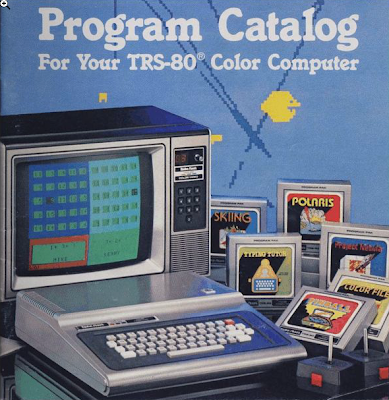
TRS-80 Color Computer, by Tandy

1982 TRS-80 Product Catalog

Tandy’s TRS-80 computer, lovingly called the “Trash-80” by aficionados, was an early home computer released in 1977, that same magical year that established the idea of computers in the home with the Commodore Pet and a little number called the Apple II.

Nothing quite gets the nostalgic fires burning as a product catalog.  So here we feature a link to a 1982 Radio Shack (owned by Tandy) catalog, profiling all the wonderful programs and games you could get for the system.  Not only is the content great, but the whole thing is presented in such a tactile way that your can almost feel your grubby hands sliding across the slick paper, drooling over the new games rolling in for your machine:

Click to see catalog

I also recommend checking out the whole site, Radio Shack Catalogs.  It is an astounding repository of promotional materials from Radio Shack’s history, and you can’t think of 70’s electronics without harkening back to the Shack.

source: tetujin via Reddit

Classic British Computers Live Again

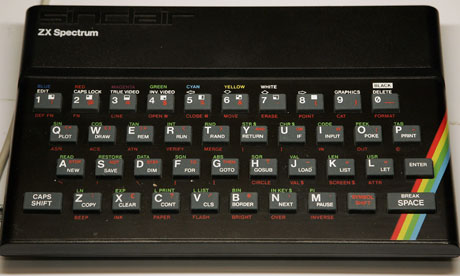
Those who grew up in Britian and Europe in the 80’s and early 90’s know all about the ZX Spectrum and Amstrad CPC.

Most people who owned one remember the Sinclair Spectrum and CPC as their gateway to the world of personal computers with big name developers like Rareware and the famous composer Jesper Kyd starting as humble home computer developers and composers respectively on them.

 Source: theguardian.co.uk

Both of these home computers had their own particular charm. The Spectrum was not designed for gaming but developers released some fantastic titles anyway despite the impediment of a lack of dedicated video. This meant games could only really display a few colours at a time from a total of seven. The CPC is remembered for its games with bright, bold colours and the unique Amstrad monitor.

Source: serious.gamesclassification.com

Games like Fantastic Dizzy, Firebird, Manic Miner, Wizball and ports of popular arcade and home console games like Commando, Altered Beast and Ikari Warriors led to the CPC and Spectrum becoming beloved amongst home computer users in the 80’s and early 90’s. Magazines that catered to hobbyist game and operating system development and the “demo scene” fueled the fires of fandom amongst Spectrum and CPC users and now their legacy lives on in communities on the internet.

A manifestation of the love the fans of these home computers hold for them is the “fan site” and what better way to celebrate these wonderful pieces of gaming history than to host some of the most beloved games on the system for play in your browser?

World of Spectrum is a huge site dedicated to all things Spectrum. Straight from your browser you can launch hundreds of games, demo discs, educational programs and productive tools. This is a huge time sink and if you love your home computers then you’ll get lost in this site for hours.

CPC Box is the home of a really excellent CPC emulator; the site doesn’t hold quite an impressive library of titles like World of Spectrum but it does provide the user with a nice big display resembling a CPC monitor and the ability to boot the CPC and play around with the command line in BASIC. This site is a lot of fun to tinker with.

European gamers must have a tonne of great memories of these two classic computer systems, and of the games that molded a generation of players and programmers. Did you grow up with the shrill loading of a Spectrum tape drive? The satisfying clacking of a CPC keyboard? Share some memories with us.